Better Government Coordination on Wildfire Resilience Will Make B.C. Stronger
Victoria, B.C. lək̓ʷəŋən territory: New research from the POLIS Wildfire Resilience Project, based at the University of Victoria’s Centre for Global Studies, recommends a transformative shift within the provincial government to address the growing wildfire crisis in B.C.
“The existing provincial structure and wildfire management approach no longer fits with the wildfire reality in B.C.,” said Doug Donaldson, senior policy analyst at the POLIS Wildfire Resilience Project and former B.C. Minister of Forests, Lands, Natural Resource Operations and Rural Development. “While the provincial government has already taken some important steps to build social and ecological resilience, an accelerated, innovative, and transformative shift is urgently needed.”
British Columbia has entered a new era defined by increased frequency, scale, and impact of wildfires. Year after year, these fires pose economic, environmental, and social risks — and this demands new and innovative approaches, say the authors.
The authors’ central recommendation is to shift to a cross-government approach to wildfire resilience, achieved through a formal mechanism for improved coordination and collaboration between ministries. This will allow the provincial government to better address the serious ecological and social impacts of the wildfire crisis.
“The provincial government must shift away from its historical primary focus on wildfire suppression,” said Oliver M. Brandes, project lead at the POLIS Wildfire Resilience Project. “Instead, it needs to accelerate and further elevate prevention and mitigation in B.C., while also advancing opportunities for a whole-of-society approach.”
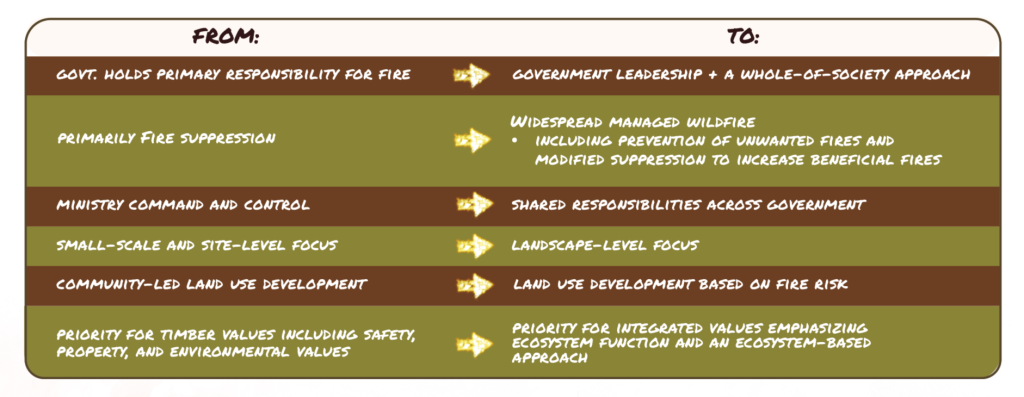
The authors propose a future arrangement for the provincial government in which the many ministries linked to issues of wildfire resilience interact through a cross-government body, with wildfire and landscape resilience at its core.
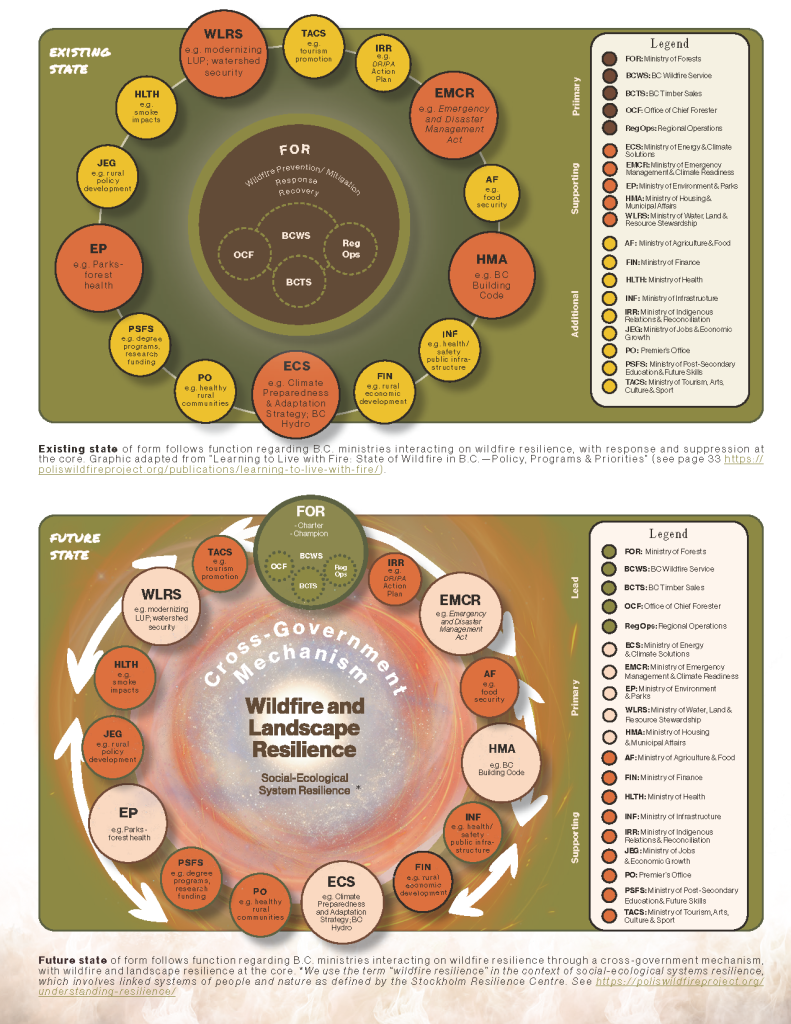
“When it comes to addressing wildfires, many provincial ministries have responsibilities and are experiencing impacts. In our view, improved coordination is the critical next step to facilitating a robust cross-government approach to wildfire resilience in B.C.,” said Donaldson. “This will allow us to build long-term wildfire resilience in B.C., which will deliver wide-ranging co-benefits.”
These benefits include protecting drinking water and biodiversity, safeguarding old-growth forests, reducing health costs, and enhancing watershed security. A resilience-based approach also allows for prioritizing interventions in areas most at risk and protecting vital infrastructure, such as hospitals, schools, homes, and transportation corridors.
To implement the shift effectively, the authors offer recommendations for developing a cross-government project charter and appointing a designated wildfire resilience champion responsible for coordinating roles, responsibilities, and accountability across all relevant provincial ministries.
“The proposed new approach can save money in the long term and lead to better community-level engagement and collaboration, increased landscape resilience, and better overall wildfire management in B.C.,” said Brandes.
-30-
Media Contact:
Laura Brandes (POLIS Wildfire Resilience Project) at [email protected]
Download “Wildfire Resilience and a Cross-Government Approach in B.C.”>


